
On their third date over tamales and tequila at on off-campus taqueria, Luke declared to Désirée, One day, I shall marry you, and her twenty-year-old self was swept away, mistaking narcissism for passion. She ached when she gazed into his ice-blue eyes, his cool confidence persuading her she was in good hands.
For his part, Luke adored Désirée’s copper cascade of hair, appreciated her not challenging him like his former girlfriends had. Désirée realized early on that arguing with him was pointless. If she questioned whether astronomy and physics could truly explain the universe, he’d wave her off and say ironically, “Have some faith, Des.” Later, when he became a professor and they could finally afford a house, he’d only consider contemporaries, said the clean lines and energy efficiency was the obvious way to go, cringing at her love of dark, oaky Victorians. Once Luke even insisted there was a correct way to cut a tomato and she just chuckled, handed him the knife.
When anger flared, she’d pour it into her art, the crimson and flame of wildfires and volcanoes igniting her canvases that she hid from Luke since he thought art frivolous, dismissing anything that couldn’t be measured, calculated, quantified. Still, Désirée was mesmerized by his intellect, relished going to the observatory on a moonless night, peering into the telescope as Luke pointed out distant galaxies and nebulae, even Saturn’s milky rings.
With the arrival of their children, Orion and Cassiopeia, Désirée all but abandoned her art, redirecting her fervor to their 35,000 BTU, six-burner Vulcan stove, concocting ever-more fiery vindaloo curries and flaming Sichuan dishes, silently willing Luke to cry uncle, though he never did.
Years later, Luke fell ill with a common cold that rapidly became an uncommon cold, but instead of burning with fever, his brow grew wintry and white. She snuck into his lab, borrowed his specialized thermometer and slid it up his rear when he was too delirious to object. But the reading made no sense. If he was absolute zero, how could anything nearby survive? Désirée’s heart raced, her legs weakened. After so long in his shadow, how to recalibrate her existence as a solitary star without his judgments and certainties? When Luke’s skin began icing over, his breath freezing like pipe smoke suspended midair, she was chilled to her core.
As he cracked apart and clattered to the floor, Désirée thought of him teasing that she was a fragile flower, wouldn’t last without him. Yet, when the coroner carted his remains away, she felt an unmistakable warmth spread through her limbs and organs, her muscles and spine girding her. By morning, her body buzzed with energy, and she climbed to the attic, pried open the dusty, sealed crate. She gripped her brushes, dabbing them into the familiar orange/red/yellow oils, softening them with splashes of turpentine, and began to paint the heat of the distant sun that poured down around her like honey from that cold, distant sky.
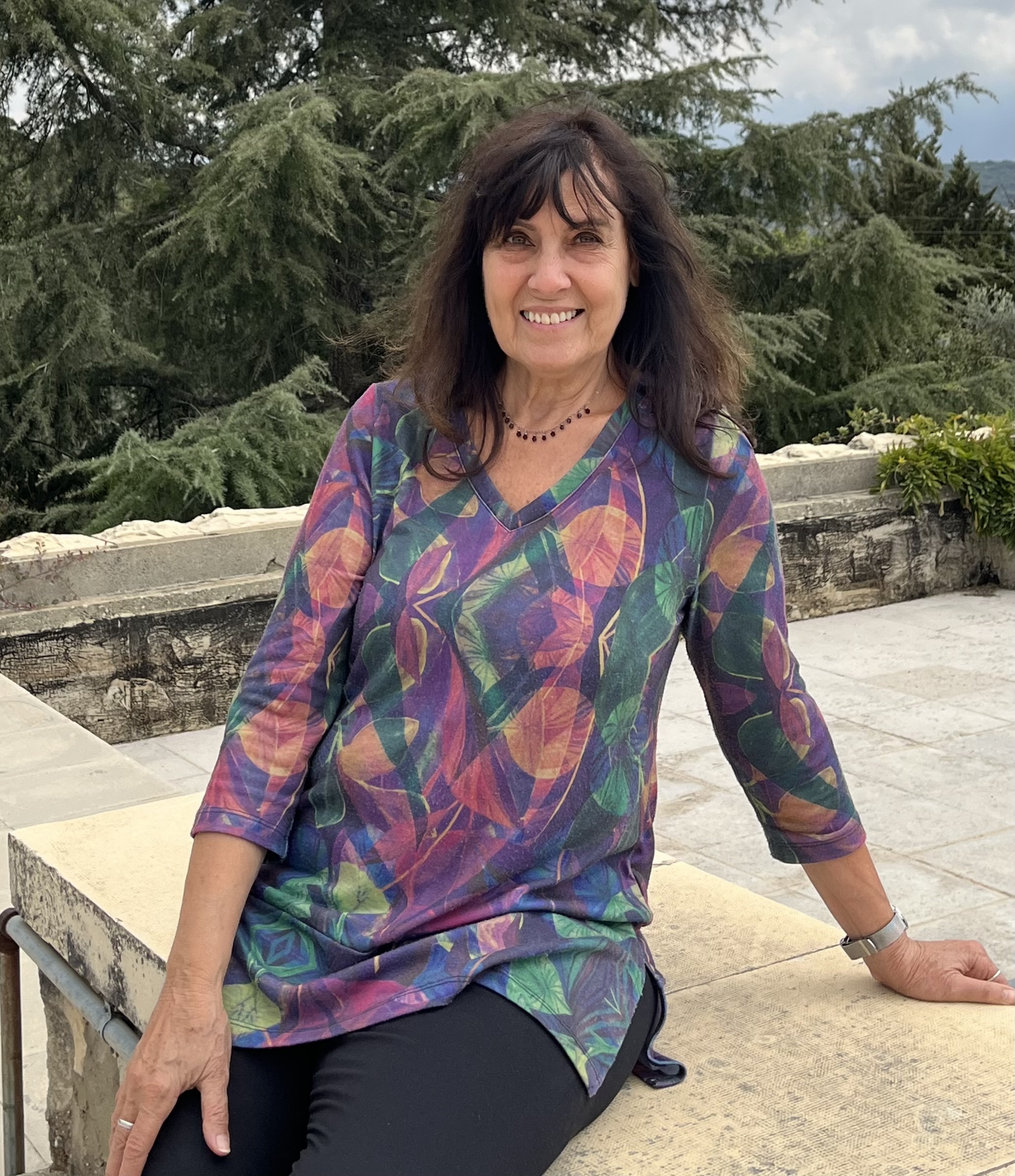
Kathryn Silver-Hajo’s work appears in Centaur, CRAFT, Ghost Parachute, Gone Lawn, Milk Candy Review, New Flash Fiction Review, Pithead Chapel, RUBY, and others. Her award-winning books include a flash collection, Wolfsong, and YA novel, Roots of the Banyan Tree.